
Carbon footprint and Agriculture
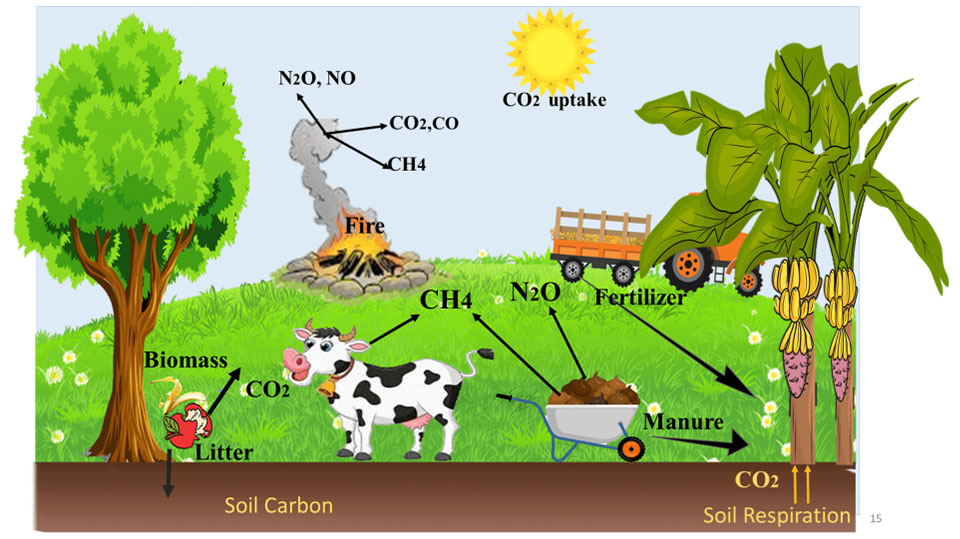
A majority of the world population is skeptical about the fact that the agriculture sector contributes to one-third of the greenhouse gas emission. As per the CGIAR (Consultative Group on International Agriculture Research) reports (2012), the food systems currently practiced worldwide are responsible for 33% of the human-caused carbon footprint. Almost all the processes involved in farming, starting from the use of fertilizers, the use of pesticides and the packing process emits greenhouse gases.
Source of farm-related emissions
A majority of farm-related emissions are in the form of methane (CH4) and nitrous oxide (N2O). Livestock bleaching (CH4) and the addition of artificial manures and thrashers to soil (N2O) contributes to 65% of agricultural emission globally. In addition to this, fertilizer management, use of fuel, rice cultivation, burning of residues, etc. are among minor sources of gas emissions. The quantity of different sources varies with different products, farming methods administrated and natural elements such as weather, water content, etc.
The increase in emissions is generally driven by a rise in population and changes in food habits in developing countries. It is predicted that agricultural emissions will increase in Asia and sub-Saharan African in the coming years.
Variations in farming methods can bring changes in the emission. Practices such as improved fertilizer management, healthier grazing lands, restoring degraded lands, etc., can reduce the carbon footprints. Alternative farming techniques like aquaponics, hydroponics, etc., can also help in creating a pollution-free environment.
Reference: 1. Vermeulen, S. J., Campbell, B. M. & Ingram, J. S. I. Annu. Rev. Environ. Resour. 37, 195–222 (2012).
2. Thornton, P. Recalibrating Food Production in the Developing World: Global Warming Will Change More Than Just the Climate. CCAFS Policy Brief no. 6. (CGIAR Research Program on Climate Change, Agriculture and Food Security, 2012
3. https://www.wri.org/blog/2014/05/everything-you-need-know-about-agricultural-emissions
Keep reading
Related stories

Growth Hormones in Aquaculture
Aquaculture is the cultivation of aquatic organisms in a controlled environment, which is also known as fish farming. Usually, it is done in coastal ocean water…
13 Nov 2021

Coral Reef Bleaching
Coral reefs are large structures, found in deep seawater which is made up of skeletons of the marine specie called coral (a class of marine invertebrates). Gene…
13 Nov 2021

The Need For Automation In Aquaculture
Automation is a kind of technology to maintain efficient production in many global industrial sectors with minimal intervention of humans. The execution of auto…
9 Mar 2021